
Retro Futures & Inner Worlds: Nili Brosh on Crafting Eventide

Guitarist and composer Nili Brosh returns with Eventide, an album that blends retro‑modern synth textures, genre‑bending arrangements, and an unexpectedly emotional undercurrent. In this conversation, she opens up about writing away from the guitar, the color‑driven instincts that shape her music and visuals, and the internal intensity that fuels her playing. From the retro‑futurist artwork to the nuanced percussion choices, Brosh reveals how every element of Eventide was crafted with intention—and how her work with Cirque du Soleil, Danny Elfman, and Dethklok subtly seeped into the final sound.
Transcript has been lightly edited for clarity.
Cris Cohen: I got the chance to speak to you a few years ago. We really went in depth with “Lavender Mountains” and “Song for Hope.” So I will link to that.
Retro-Modern Soundscapes
It’s interesting hearing those now in this full album, as it takes you on this journey. You described this album as “going for a retro-modern feel.” I think I know what you mean by that, but I’m wondering if you can elaborate.
Nili Brosh: Some of the retro sounds in “Pastel Dreams,” for example, or “Eventide,” some of the vintage synths... I’ve always loved that vibe, and I wanted to put my own spin on it. I think some people probably hear older influences in my playing to begin with. So I don’t think that’s something foreign with me when it comes to people’s perception of my playing.
To me, it’s always kind of an amalgamation of where we came from, and how can we put a newer spin on it? Because it is 2026. And no matter what we do, it’s going to be something that came out now. So I guess that’s the modern part of it.

Visual Identity & Retro-Futurist Aesthetics
Cris Cohen: And even the artwork for the album I would describe as retro futurism. As a guy who grew up reading these books by Isaac Asimov and Ray Bradbury, it had kind of the same style as the covers of those books. I’m wondering how much input you had into the visual aspect of that album.
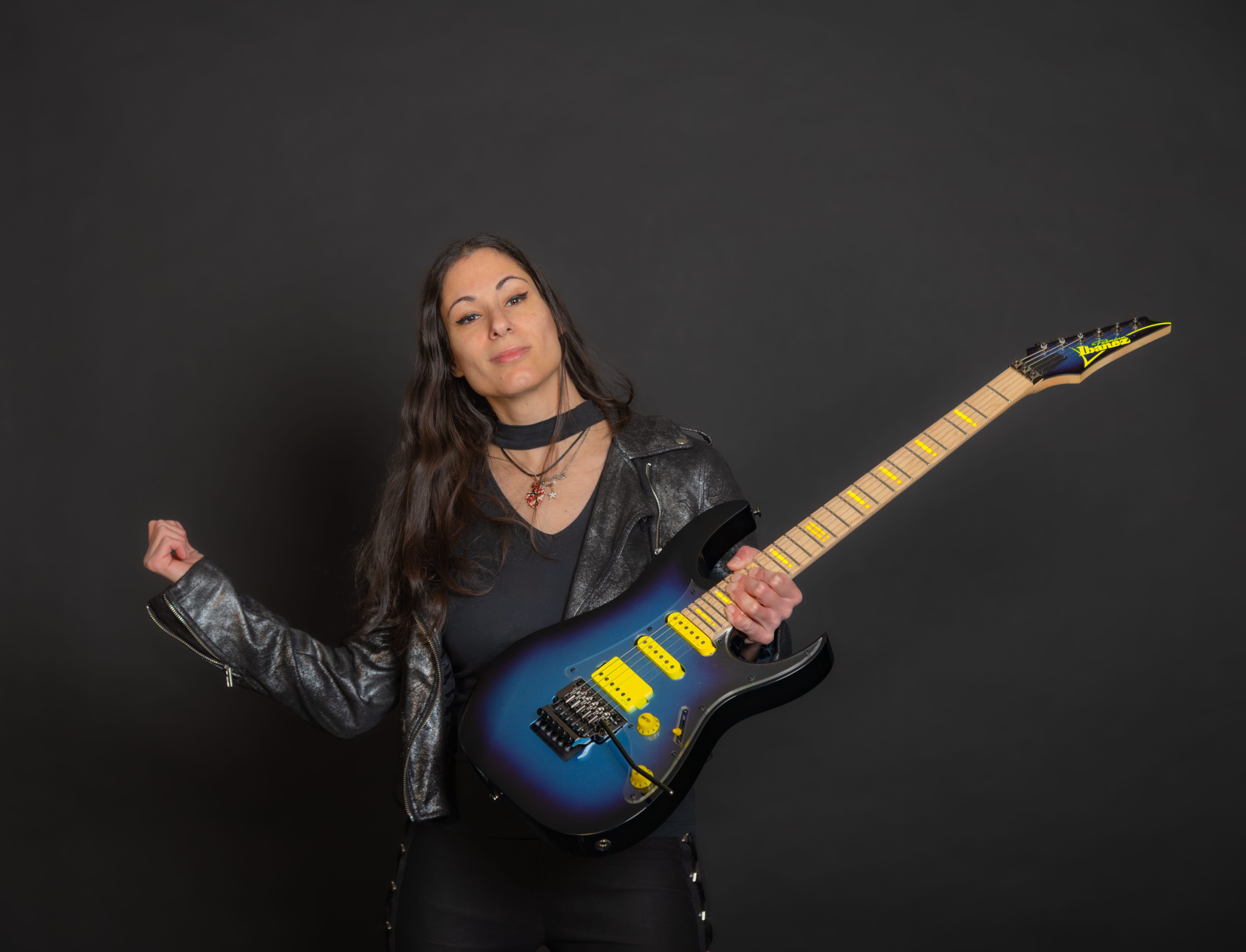
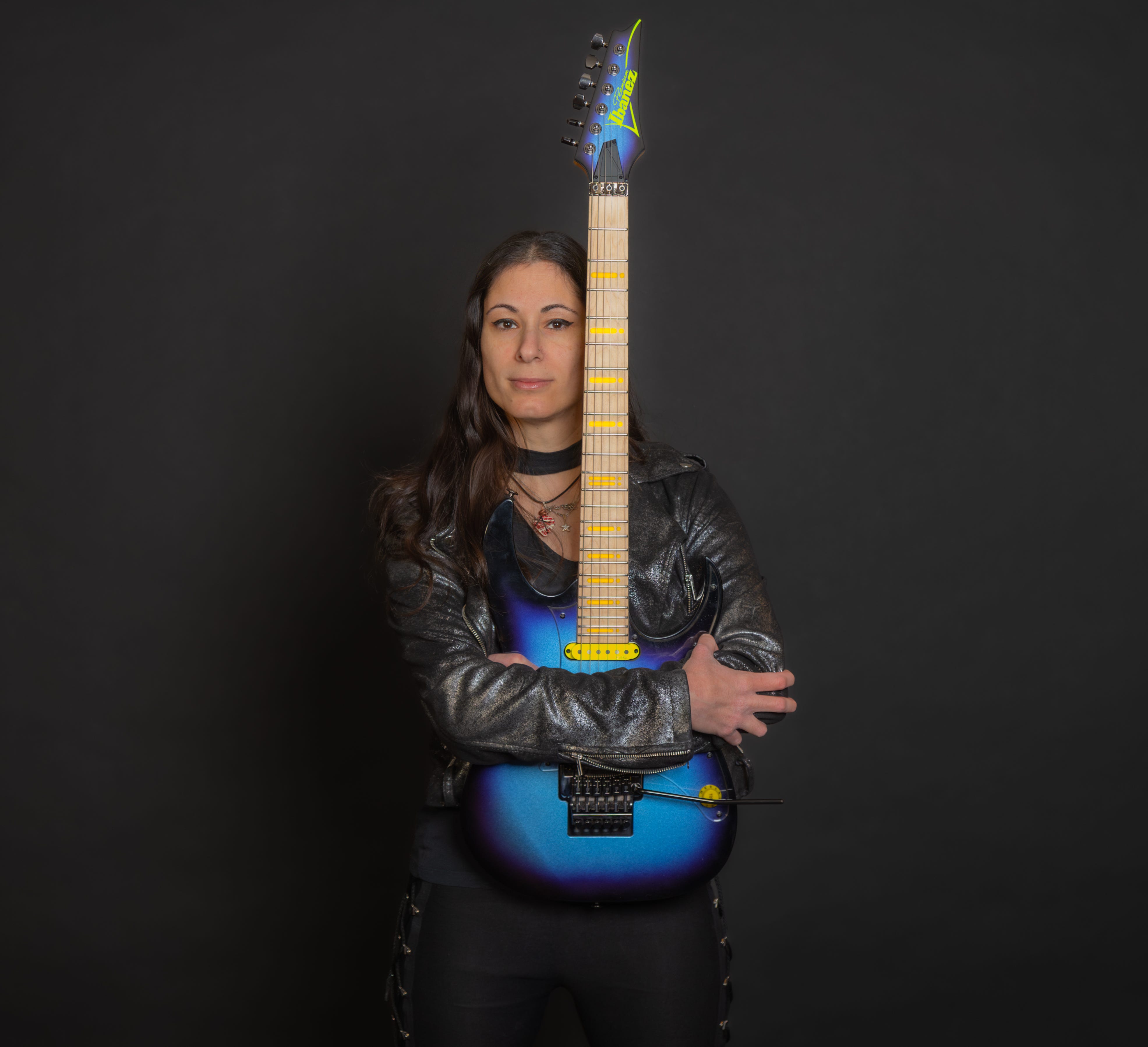
Nili Brosh: That was definitely not an accident. I didn’t exactly control what the cover art was, but I definitely gave the artist, Flooko, a vibe and a direction. And he’s heard the music, and he knows what the whole thing is about. So it was intentional, trying to capture that visually and make all the visuals -- whether it’s on the album or the music videos or my signature guitar -- be a running theme with the music, how I not only hear it in my head, but what I see, what colors it corresponds to in my head, and how I internalize it.
Cris Cohen: And other people have noted the similarities color-wise with your signature guitar and the album artwork. I’m always interested when the artist has a vision that they’re trying to share visually. And obviously from what I’ve read, you had very definite opinions about what your guitar should look like.
Nili Brosh: And these were things that we’ve been working on for years, trying to get as close as we can to how I see it. So I think it was a worthwhile journey. And I’m really proud of how it all became a running theme, because it doesn’t always feel easy.
You can kind of see in your head what you want to do. But whether or not you can make it actually convey that, getting from point A to point B, is not always clear.
Hearing the Album as One Story
Cris Cohen: You’re preparing for solo shows that you’re going to be doing in Europe to promote the album. As you do prep work for that, are you now hearing more of a cohesiveness to all these songs that evolved over the last few years, now that they’re all being played as part of one show?
Nili Brosh: Totally. One thing that really helps with that is when you start mixing and especially mastering the record. You put it in a sequence, evaluate masters, and really hear it in order. You hear it as a running theme, as a cohesive piece for the first time. Shuffling that around and making the last tweaks on it. It’s really helped me see it as one thing, one entity.
But yes, putting it into the show, especially with older tunes, working on the sequence for that, and getting to the point where I’m not just playing it to record it, but I’m playing it to perform it, definitely breathes new life into the thing.
Writing Away From the Guitar
Cris Cohen: There are some really interesting aspects to this album and these songs. Some of the songs have intros that you would never hear on your typical guitar-oriented album.
It is really interesting. “Pastel Dreams,” starts off like a Pet Shop Boys song, with the retro synths.
“Every Player Wins” starts off with a rapid fire Latin conga. How did those intros come about? And was that also part of your thinking for the songs or did that come about later when you brought in, percussionists and such?
Nili Brosh: No, that’s part of the writing. I really do my best to write away from the instrument as much as I can. I like to hear things in my head and jot it down as notes and voice memos.
The melodies will most likely be played by a guitar. But the arrangement around it is whatever I hear in my head. And I admittedly like a lot of synth stuff.
I like sneaking it in there. It’s all in service of the tune, service of the music.
To me, “Every Player Wins” is a heavy tune, but it always feels like kind of a Middle Eastern tune to me. So I’m thinking, “That type of percussion would be very prominent in that kind of music.” And I actually had the guitar line, the main guitar line from that tune, as an intro for the longest time and then had the percussion come in. I just didn’t like it.
I feel like the percussion rolls out the red carpet a little bit better on this one. I go with whatever services the music better.
Cris Cohen: I like that idea of rolling out the red carpet to set the scene. Also because it’s so unexpected.
Nili Brosh: And I love it like that.
It’s another genre that I like. It’s another direction that I like dabbling with.
Cris Cohen: Getting back to the line, “I like to write away from the instrument,” I would think most people would assume you have a guitar in your hands 24 hours a day, always noodling. Is it more that you sing these parts and that’s how you get the ideas out of your head?
Nili Brosh: Yes. I sing the parts into the voice memos.
If I hear any other arrangement ideas around it, I’ll take notes on it. I’ll sing the drum groove.
Everything is with the ear leading first. I’ve always believed that sometimes when you have a guitar in your hand, most people can overplay. That can derail you. That can turn a really good, succinct, cohesive idea into something that now has too many notes, or is now unrecognizable. I don’t want that to happen.
I want it to stay true to what I heard and have it develop from there. It always goes back to the ear.
Cris Cohen: I would describe a lot of your playing as very lyrical. I know there aren’t lyrics, but you sometimes swear there are lyrics.
Nili Brosh: That’s the idea. It’s songs without words.
Synesthesia & Color-Driven Creativity
Cris Cohen: And it’s interesting, this whole idea of, “I’m going to translate what’s in my mind into music.” Because in reading the materials that were sent along with this album, I think it’s the first press release I’ve ever had that mentions synesthesia.
The idea that within your mind, something from one sense triggers things in another sense. Sounds trigger sights. It’s a fascinating idea.
There was a book called “Born On A Blue Day.” It’s about this guy who was, for lack of a better term, an autistic savant. He saw numbers as colors and shapes. As a result, he can memorize the number pi out for thousands of digits.
You said you have “a touch of (synesthesia).” How does this manifest within you?
Nili Brosh: This is a self-diagnosed thing. There’s no proof that I really have anything like that, or what the extent of it is.
But to me, I’ve seen either certain key areas as certain colors, or certain tones, certain keyboard tones as certain colors, or certain reverbs as certain colors. It corresponds to a color palette. The more fleshed out the idea is, the more it seems like a certain hue.
Cris Cohen: Have you tried to use that to explain to other musicians what you’re looking for?
Nili Brosh: I haven’t really done that. When I give other musicians demos to play over, they hopefully already have the direction conveyed in them. It’s not to say that every musician is going to go and play verbatim what I had in the demo. But it’s usually fleshed out enough for them to know, “This is the range or the vibe that I need to be within.”
If that doesn’t really fit, then we can talk about how to make that closer. But that usually happens more in musical terms.
Smooth Transitions & Genre Bridges
Cris Cohen: Another track that really stood out for me on this album is “Tip The Cap.” It has these really cool, subtle transitions.
A lot of the song seems to swing from… it reminds me of the piano section of “Layla.” It’s kind of a lush, emotional thing. But then it swings into this contemplative jazz thing. Then it swings back, but it’s smooth.
What’s the key to doing that so smoothly?
Nili Brosh: I don’t really know. I think it’s trying to understand what similarities genres have between them. Because at the end of the day, there’s always something in common. And that’s something that I really had to think about with my last album, Spectrum, which really morphed from one genre to the next.
However different two genres seem, there’s usually something that the two of them share. Whether it’s certain grooves or certain chord progressions, even if it’s not the instrumentation. There’s always something that unites two things when you don’t think it might. I try to go between the things that are more similar. I think that gives it a smoother transition, rather than trying to connect them by the things that they don’t have in common. Finding the commonalities and trying to smooth it out from there I think helps. Because jazz and classical, nylon string playing, I don’t feel like those two are too far from each other.
And vibe. You’re not going from a super-loud, heavy thing to low dynamics, solo, nylon string guitar. There are great ways to marry those that people have done that don’t have to seem jarring. If you take the similarities, I think it’s a lot easier to weave together.
Cris Cohen: With the idea that songs are kind of a window on a person’s soul, it’s interesting to have a song like “Tip the Cap.” To make this sudden turn into this kind of acoustic area, it’s like, “Wow, there’s a whole other facet to this musician going on here.”
Nili Brosh: That’s the idea, to give kind of just like a little window.
The Hidden Intensity Behind the Calm
Cris Cohen: It’s funny because the way you are in conversations… you’re very mellow, calm, easygoing. And yet a lot of your playing on this album and others, there’s this dark grittiness to it. “Losing Grip.” Gritty rockabilly. That grittiness, where do you pull from personally to get that out into the music?
Nili Brosh: Maybe it’s not obvious in conversations, but I feel a lot of internal intensity and anxiety. I feel like it’s easier for me to get that out on a guitar. That, to me, is my natural default on a guitar. To go harder is easier for me than to back off.
So it’s interesting that you say that. I definitely have my anxious moments where I can’t relax. Relaxing doesn’t ever feel like my default. That’s something that I have to work a lot harder on. So pouring more out of it on a guitar is a lot easier for me than restraining myself.
Life On and Off the Road
Cris Cohen: A week or two ago, you had this post where it was like, “A musician off the road.” And it was you being neurotic.
Nili Brosh: Exactly. You wait for that moment. I have so much to do all the time. There are so many balls in the air.
You think you’re going to enjoy that earned day off whenever you get to it. And then you get to it.
And I’m like, I don’t know what to do with myself. Yeah, I struggle with that for sure.
Cris Cohen: Okay. So it wasn’t just a joke.
Nili Brosh: It was not a joke.
It’s also abrupt. When a tour starts, it ramps up somewhat gradually. But when it stops, it stops abruptly and you hit a wall. And so sometimes, it’s hard to process that sudden stop.
Sometimes dealing with that can be tricky.
For me, it has to do a lot with how I feel I performed. Sometimes I’ll have a really bad habit of analyzing how things went. It dawned on me that you’re looking for something to process because you don’t know how to put an abrupt stop to it.
Sometimes your brain doesn’t really know where to put that until you’ve kind of had a chance to mull over it.
Cris Cohen: Interesting. I never thought about that.
The Mental Whiplash of Live Performance
It also reminds me of conversations I have had with Ben Sesar, who is the drummer for Brad Paisley. He talked about the times when the set list has something that’s going 100 miles an hour, and then the next song is a ballad.
Nili Brosh: Yeah.
Cris Cohen: And trying to slow, because you’re mentally still going 100 miles an hour…
Nili Brosh: Calming down the nervous system like that in spurts and going back and forth is not the most natural thing in the world. Trying to stop it and telling your body, “Now, take it really chill. Don’t rush.”
That’s hard.
Cris Cohen: It also reminds me of the work you do with Cirque du Soleil’s Michael Jackson show, where you actually leave the stage at points and come back.
Nili Brosh: Yeah. That’s a totally different animal than being on stage and playing for a show. And even with Danny Elfman, there’s its own version of it. There are times where the orchestra will play film music that we don’t play. We stand there and watch the orchestra. And that’s a lot of time to think.
That can be even stranger, because you’re still on stage, you’re still being seen. I mean, there’s a lot going on on that stage. So no one’s really paying attention to you.
But at least at Cirque, you get good at going back and forth like that. Every show has its own set of challenges when it comes to that.
And it definitely keeps it interesting.
Cris Cohen: I never thought of how that can really kind of screw with your mind.
Nili Brosh: It totally can. But you know what, so can staying on stage and playing through it, because then you’re off to the races. That’s a different animal too.
How Her Gigs Shape Her Sound
Cris Cohen: You’re three regular gigs are with Danny Elfman, Cirque du Soleil, and the band Dethklok.
In what ways did those bands / gigs influence or inspire what’s on this album?
Nili Brosh: I think they always do. I think it always gets in there in ways that you aren’t necessarily even aware of. I think with Dethklok, I use the same guitar with the low tuning, the C standard tuning, on this record, just because that’s where I was at the time.
And then when I recorded it, and I was like, “I have to do all the rhythm parts with this guitar, because they get kind of low.” But then everything with the leads ended up being in strange keys for me that I don’t normally play in. But that’s how the song was written. So I adapted.
The Most Challenging Track
Cris Cohen: What was the most challenging song on Eventide to create as far as getting a finished, polished song?
Nili Brosh: That’s a good question. You know, they each have different challenges, whether it’s how to mix it, or getting the right people on it. But I think a lot of times, when I’m dealing with genres that are newer to me, or that I feel less familiar with, there’s always a question in my head about whether I’m really getting it to where I want it to go. Not necessarily how it should sound, but whether it’s authentic to me.
So, maybe “Every Player Wins.” That had a lot of nuance, both the playing and the instrumentation and getting the right parts to come through.
Cris Cohen: I can’t imagine trying to arrange all those layers, so that they are so cohesive.
Nili Brosh: That’s why my albums take a while. I try to give it the thoughtfulness that it requires and not just finish something because I have a quick deadline and have to get a new album out there. I want it to be thought out and conveyed the way that it should be.
Bands To Fans: I help professional musicians turn casual fans into genuine fans.
If you would like my help, send me a direct message.